Showing posts with label What I Do. Show all posts

Sunday, July 28, 2013

Supply Chain Silliness

Last week we had the priveledge of preparing an order of 5 scotch locks across Africa. Total value of said order 92 cents US. Total cost to DHL 5 small plastic objects, prepare invoices, shipping documents, taxes etc.. is probably on the order of several hundred dollars or  more.


Why would any sane manager approve such a ridiculous transaction?. After all you can  buy scotch locks direct from 3M. I suppose that answers can be found in the sometimes bizarre world of supply chain management and how items can be classified as surplus if they sit on the shelf too long. Apparently common sense takes a back seat if these tiny plastic objects sit in a bin for more than 6 months and the high cost of moving these items frivolously is not factored into the cost of holding those items in a specific location. Is it really too much to expect folks to step back from a supply-chain management program that they really understand and ask themselves what they are really about to do?

Apparently it is


Friday, July 8, 2011

Oversights

D'Oh - Homer Simpson

Oil wells are getting deeper. They are becoming more convoluted as well. This has created a lot of niche services and service companies, and a whole new host of problems which would not have even been considered a few years ago. For example a client of ours recently requested the latest and greatest in high strength logging  cables. This stuff  has phenomenal tensile properties and if we utilize it to its full capability we can pull a great deal more tension on it then what is usually allowed. That means you can run more tools simultaneously while reducing the risk of leaving those tools in the well should they happen to become stuck. Unfortunately our client won't be able to use that cable to its rated load. You see you have to support that cable with something, and that something needs to be a whole lot stronger than the cable. The client never told the rig what they had in mind and they have only just realised that the rig's support points are inadequate for the cable they specified. The rig can't change their support points - its already at sea. So an entire drilling and evaluation campaign has to be changed because someone couldn't see the entire picture.
The amusing thing in all of this is that our client has us running around like chickens trying to solve  a problem, for which we have no reponsilbility, and yet are expected to sort out - for free of course. I can forsee some very expensive solutions coming. Machine shops...chartered aircraft....

I suppose this whole exercise would be the equivalent of throwing a formula 1 race engine into a Yugo, or a Gremlin, or even a  Pinto. You are going to be disappointed. no matter what you do next.

Friday, March 11, 2011

An Oilfield Rant

I was rudely interrupted from a much needed repose to prepare equipment because some rig out on the ocean somewhere could not get their pipe out of the hole. Just when I planning a nice little trip home I had to rebook all my flights....such is life.

Drill pipe gets stuck. It gets stuck for a number of reasons. There could be differential pressure across the wellbore, shales swelling in, poor solids control, or any other number of reasons as to why the rig can't get the pipe out of the ground. Usually when drilling rigs get stuck they need wireline people to get them unstuck or backed off. Its about the only time when the drilling supervisor is happy to see us.
Part of the challenge in freeing stuck pipe is to select the most appropriate means of cutting the pipe above the stuck point. This means choosing the right explosive for the job. Furthermore little foresight is applied by drilling and completion people in terms of designing a completion than can be recovered if necessary.  A drilling or completion string may have a number of restrictions in it that complicate the pipe recovery process. The burden falls on the service company to provide a cutter that can satisfy the customers drill string however screwed up it is.

So here is a Drillers Dream Cutter

Can cut any size casing, tubing or drill pipe.
Able to fit through a 2" restrictions
Requires no explosives or dangerous chemicals
Includes a free point device as well as correlation device
Can be rigged up easily with no special power supplies or personnel

Unfortunately such a device is still within the realm of fantasy. In the meantime we have to go through the tedious explanation of why you can't use a 2 3/8" cutter to cut 5 1/2" drill pipe. Eventually this message sinks in and our clients re size their expectations as to what is actually doable.

The next difficulty is to determine where the pipe is stuck and to convince the client that he needs to cut above the stuck point if wants to have any chance of recovering any pipe. You would be surprised at how many millions of dollars of drilling hardware are lost in the well every year because Drilling people can't understand this simple concept.

Details. You can never have enough. Its surprising what you don't know and how that can make or break a job. A lot of time can be saved beforehand if only people knew the ID of a piece of assembly was 2.25" and not 3.5". We had to run a drift just to confirm an ID because some guy in town couldn't be bothered to gauge an assembly.

Hindsight is always 20/20. I think that the oilfield has the most disproportionate number of armchair quarterbacks in the world. Anyone with 2 years experience on the rig thinks that they are an expert and I think I heard more sentences beginning with  "we should have" than I have since that last time |I was out here to free stuck pipe. Service contracts are not written for should haves. They are representations of what level of risk that operators are prepared to accept  - if you are worried about losing a 50 million dollar well then you "should have" built that into your contract.

And finally....CYA (cover your ass). The acronym CYA almost completely sums up the entire exploration industry. Never leave yourself in a position where you can be held accountable for anything. Although this means that the job safety review will be a 30 page document translated into 2 languages for a 10 minute operation this is the way things are trending in the patch. Cutting through the bureaucracy means self-exposure and I can't afford the risk.

Get used to it. No wonder the price of oil is hitting $100 dollars plus.

Tuesday, January 4, 2011

On Nested Polynomials

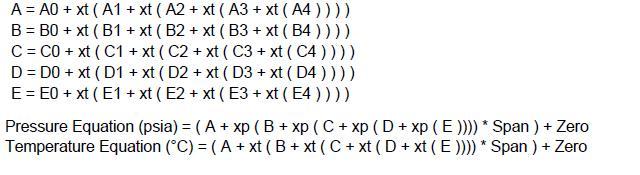
At work we use quartz pressure gauges to measure downhole pressure in a reservoir. The gauges are extremely accurate and employ a clever temperature correction scheme. They are calibrated at a test facility somewhere in the States and sent to us as a kit. The calibrations take the form of nested polynomials, the coefficients of which have to be entered manually into an acquisition system. Apparently computers prefer crunching this form of equation to the regular type. Here is what they look like (more or less).


So just figuring

  • 25 Coefficients per internal gauge 
  • 3 Internal Gauges
  • 4 Coefficients per external gauge
  • 29 Coefficients per Internal/External Combination
  • 9 Possible configurations means 261 coefficients to enter (manually) into the system.
The possibility of typos is tremendous. Luckily the system allows some test values to be input so as to generate a known output. Its fairly easy to check if you've made a mistake. Still its a lot of typing for the two-fingered. Once all the calibrations are entered then the gauges must be phsically checked (in their various combinations ) just to ensure all the points are entered in the right places. Lots of unscrewing and screwing involved here.

This will take all day...I'm already pooped.

Saturday, December 25, 2010

A Non Christmas Poem

This wll probably be my first and last attempt at rhyming couplets. I really need a change from writing deployment risk management reports. Here goes...

It was the night before Christmas and I'm stuck in a stew
Trying to fill in my performance review
Just a few short lines to fill in a gap
In some global database, managed by SAP


I'm advancing the enterprise I quickly cajoled
Exceeding my metrics and meeting my goals
Conform to requirements with a flick of the wrist
Careers are tick boxes, just fill in the checklist


I'm finding it hard understanding this goo
The sylables are many their meanings are few
Designed to mislead, to confuse and to skew
It looks good on paper who cares if its true?


Ah all that I've written its not what Ive done
It just for a raise at the end of Q1
At the end of the day its not what you do
Its how you report it (subject to review)

Thats probably enough


PJ wishes everyone a Merry Christmas and all the best in 2011. May your performance metrics show continuous improvement, add value to the enterprise, meet or exceed industry benchmarks and comply with stakeholder expectations (both internal and external) thoughout this reporting period.

Tuesday, September 21, 2010

Detours

I took a short time out on my way home to do a weeks training in Montrose, Scotland. Its been a very interesting few days in spite of the weather being rather chilly. Ah the joys of high winds and freezing rain. The course itself has been very interesting and informative. Its also been a chance to visit some old colleagues who are now instructors at the company training centre and catch up on the juiciest bits of corporate gossip from the north sea world.

I found some time to take some photos along the way. Please enjoy.

Scotland, Or western Alberta?
Starting out from Aberdeen its about an hour to get down to Montrose on the train. Some of the countryside looks surprisingly like Western Canada come harvest time. One thing I like about the UK is that the trains actually work and are a convenience. The 2 hour round trip from Aberdeen costs about 17  pounds. The taxi from the the airport to the train station costs about the same.


High Street,  Montrose Scotland
 First off note the cut-off statue of the bloke on the right of the photo (try to ignore my lack  of photography skills). He is one James Graham, the  sixth Earl and first Marquis of Montose. The man lived a very interesting life and unfortunately experienced a most gruesome end in the time when  Oliver Cromwell was running things round here. Remember "Braveheart" and how they did in Mel Gibson at the end? Same story for this guy. Actually in light of his demise a cut-off photo is somehow fitting .

The church steeple is spectacular - it was built in 1832.

Montrose Public Library
I put this in because I like the building. The library was built in 1908 for "a grand sum of 8000 pounds" according to the local watchman. It just happens to be across the street from a takeaway joint that I frequented during my stay. Not much to do while the pizza is in the oven. The library is nice on the inside as well.


The Dog Park
Found this on the sidewalk. Until today I have never seen an urban parking spot just for dogs. What a great idea. I daresay you would need something a little bit sturdier for anything larger than a Jack Russel.


Medal Course At Dawn
Montrose does have a couple of nice golf courses. Unfortunately I did not find the opportunity to play!. It just wouldn't do to have a post about Scotland that does not have a golf photo in it.

Graduation Picture
I did go to Scotland for reasons other than getting photos for this blog. The course entailed the evaluation of Cased Hole Logs and was attended by a number or folks from various oil and service companies. The instructor (second from right- back row) was quite engaging and I found the lectures to be very specific to what I am doing now. Its a subject that is getting more attention especially since that BP disaster in the Gulf Coast. All in all it was a week well spent. Now its time to get home.

Wednesday, May 26, 2010

On Oil Spills

That  BP spill in the gulf is going on for some time now. Its certainly become a problem, judging from all the lawsuits being filed for BP, Haliburton, Transocean, and Cameron. Eventually all the facts of this tragic event will be unearthed in the discovery process (I think discovery is the correct legal term). In the meantime its worthwhile to note a few points about how the industry operates and the political games being played by the government.

The US government has threatened to take over relief efforts on this well. Personally I doubt that the Feds have either the technology or the expertise to perform this kind of operation. Given their impotence its sadly amusing to hear them carping away as they are. Probably the best they could hope for would be to hire another oil company and put them in charge of capping and clean up - wouldn't that be interesting? The experts in this field are most likely to be found in the Gulf coast oil industry where they drill some the most deep and difficult wells in the world. The feds couldn't organise blankets during Katrina  - have they suddenly become well control experts?

There will probably be several  lengthy investigation into all aspects of this disaster. Each of the companies involved have been investing heavily in compliance (ass covering) for the last 10 years or so. In an industry where every action is scrutinized and reviewed the problem will be actually a surplus of information. Even a minor service failure or departure from routine procedure warrants a page in the End-Of-Well Report. Whole forests will be needed to publish the report on this well.

There is a strong need to find out what went wrong on this well, and how it can be avoided in future. Eleven men during a routine operation. Beyond any possible environmental impact this may have its crucial to remember that lives have been lost. Without knowing the causes it will be difficult to confidently drill into these deepwater environments in the future, not to mention finding crews to do the work. The nature of the tendering process puts safety at a premium these days and company records have to be available and traceable in order to qualify to tender. In other words, without resolution on this issue it will be very difficult for the companies associated with this well to get other work. Large multi national companies such as BP are especially anal in this regard.

The press has gleefully taken the opportunity to bash the industry. I suppose it doesn't sell a lot of newspapers to focus on what went wrong and make even a cursory check of the processes involved. Instead we are reminded of the "scandalous rapacious greed" of the multinationals and how this spill will singlehandedly destroy the planet. As to multinationals its worthwhile to note that the largest of them Exxon Mobil is only the 17 largest oil company in the world. The 16 larger oil companies are all National Oil Companies (NOCs). In reality the largest oil companies in the world are political tools with no real accountability to the public. If this disaster had to happen then the best group for it to happen to is a large multinational oil company - at least there is an internal process of accountability. Its also worth noting that Governments at every level take a cut on every barrel of oil produced - oil is probably the single most heavily taxed commodity on the planet. Just who is being scandalously rapacious here?

The question of environmental damage is certainly a tricky one. Certainly there will be damage. Predictions of wiping out the wetlands are, in my opinion, wild hyperbole. For one thing oil has been seeping naturally into the gulf for millions of years, quite a volume in fact. So why isn't the gulf a wasteland? There are microbes in the ocean that actually live on oil. These microbes, when left to themselves have done a pretty amazing job in cleaning up spills such as the Amoco Cadiz spill in 1978 and the Exxon Valdez in 1989. Human intervention by way of detergents and bioremedials often do more harm than good. Problem is of course that mother nature takes time. The people affected want the problem fixed right now which is which is reasonable but not realistic.

Its important to me personally that the root cause of the BP blowout in the gulf are determined and drilling practices are refined to minimise the risk of this kind of accident ever happening again. I have no desire to test drive first hand the ejector pod type lifeboats currently in use. Knee jerk calls to stop drilling and/or end today our dependence on hydrocarbon fuels may sell at lot of newspapers but really help no one in the long term.

Sunday, March 7, 2010

Caipirinha Time!

I am sitting around in Luanda with the boys drinking homemade caipirinhas waiting for supper to arrive. For the heathen amongst you capirinhas is a mixture of limes, sugar and cachaca (a lethal sugar cane extract). It tastes quite refreshing actually so long as it’s cold enough. We are celebrating here. After months of preparation, endless invoices, equipment checks and commissioning we were finally able to deploy our equipment, get it working, do our job, and get back to the beach, all without losing anything or killing someone.

It didn't come easy. We had issues with air conditioners freezing up at inopportune moments. In 100 degree heat can you imagine being in a sealed metal box without ac? For a week? The heat played with our computers causing them to cycle on and off repeatedly. The hydraulic generator that we were using also had issues which caused frequent power cuts to the unit. But these little hang-ups were not enough to overly affect the final result which was a successful well intervention and the acquisition of good data to the client. We also had a good opportunity to test our modelling software and make some adjustments for the next intervention which will occur in about a month. I’ll be travelling to Bali in the next day or two but in the meantime it’s back to the caipirinhas!

Sunday, January 10, 2010

The Offshore Experience


Fancy the movie star lifestyle of an overseas oil worker? Who wouldn't? Here are some things you can do at home to simulate that offshore experience. Try them out for yourself and then ask yourself "how much should they pay me to put up with this?"

The Ride Out

If you are lucky you will be on a helicopter. Find four of you largest friends and stuff yourself into the back of an Austin Mini. Make sure that the engine of said mini has no exhaust manifold. The noise and smell are essential to the experience. Get the driver to randomly swerve or brake the vehicle. Remain in your cramped position for approximately 2 hours. For the extreme simulation nobody is allowed to shower for at least 24 hours prior to departure and a diet of brussel sprouts and kidney beans is mandatory.


The Offshore Office

For this simulation you will need a space slightly larger than a closet. You will be spending 12 hours or more per day in here so it’s important to get the ergonomics right. Your workspace should not allow you to stand completely upright if you are over 5' tall. Air conditioning should be one of two types; artic or non-existent. The ambient noise can be simulated by installing several vacuum cleaners inside your workspace and switching them all on. Next, find a 50's style loudspeaker, set it to full volume, disable the volume control, and place the speaker approximately 15 cm from where your head will be. The speaker can be connected to a microphone located somewhere else in the house. At random intervals have you wife, girlfriend or significant others scream into the microphone that the mud weight is now 9.7. Even better if they can randomly operate an impact drill for several minutes at a time or just beat a hammer against a piece of pipe repeatedly. Need to use the toilet? No problem. Just go up and down eight flights of stairs each time you need to go. Alternately you can walk 5 times around your house. Before you leave your "workshop" however you need to put on a hard hat, steel toed boots, safety glasses,earplugs and gloves. Remove these items upon entering the toilet area and put them back on when you leave.

Your Accommodation

Sometimes the rig accommodation can be quite nice. Single rooms Television sets, internet connections, and the like. Those sorts of accommodations are reserved exclusively for oil company personnel and senior members of the rig crew. As a service hand you will never ever see these rooms. Expect to be sharing your room with at least 3 others and your bathroom with at least 7 others. Guaranteed there will be at least one who snores like a freight train and another who has some sort of annoying idiosyncrasy such as hawking up their phlegm or continuously flossing.

Your Job


To simulate this find someone someone to follow you around and record in minute detail every moment of your workday. These daily reports get collated at the end of the well into thick reports complete with pie charts and process diagrams that illustrate with a clarity only hindsight can provide where you supposedly departed from the critical path of your job and why the oil company should withhold payment for the 3 minutes of non-productive rig time that you spent re-booting windows or using the toilet. At a million dollars rig charges per day it’s easy to find people who are this anal. Wellsite witnesses make a living by trying to demonstrate your incompetence to Oil Companies - if you must deal with them use either simplistic language suitable for 2 year olds or overwhelm them with technical jargon as to the possible reasons why the induction tool response is not following its expected profile. Information imparted freely to customers will generally be used against you so keep it mum - less said the better.

The Return Trip


Part of the fun of working offshore for a service company is that you never really know when you will be going back. Could be a day. Could be a week, or even a month or two. The usual case will be that the company man decides at the last minute that he needs the bed space and will tell you to drop tools and get on the chopper that is arriving in 5 minutes. You scramble like wildebeests trying to simultaneously pack your things, finish your job and leave your workspace in some semblance of order for the next guy coming out. Typically you realize, while stuffed into the chopper halfway home, that your watch is still sitting quite comfortably in the rig accommodation  just waiting to be nicked by the first bloke who happens along.


If this is the sort of dream existence that makes your heart beat a little faster then by all means get into the oil business. Prices are going up (at the moment) and the panic layoffs of 6 months ago are slowly turning in to the where-do-we-find-people mindset that is furrowing my boss’s forehead as I write. Otherwise I suggest that you get a normal job and remain blissfully ignorant of the hoops we in the patch jump through to keep gas in your tank.

Monday, December 14, 2009

A Dilbert Moment

Dilbert.com


Our company has a lot of really clever people working for it. They hang out in a group called operations support whose job it is to take questions/problems from the field and come up with new ideas, workarounds, or solutions to these questions/problems. There is in fact a website dedicated to this process and you can follow the status of your problems as they work their way through the system. Generally it works pretty well and makes for some interesting reading.
So much by way of introduction. A while back I had been asked by  sales what limits there were on the weight of a tool string that could be effectively picked up on a piece of cable (sorry here is where stuff starts to get a bit technical). Most our documentation (and industry for that matter) deals with safe working loads and failure loads under static or near static condition. We can design a tensile weak point to pull out at 10000 lbs give or take a few pounds due to statistics and temperature. The same weak point can be pulled to say 7000 lb a million times reliably without ever experiencing a failure. In light of this it was suggested that for this application we could put a 7000 lb weight on this cable with no issues right?
Well not really.
The dynamics of moving that cable up and down in a wellbore haven't been taken into consideration. F=ma and all that. In other words by suddenly stopping a cable with a large weight on the end of it may exceed our 10000 LB weak point limit. And that means our million dollar tool falls off the cable and we would look like dorks for suggesting that we run a tool that size on cable in the first place.
Problem is we haven't done any research into this, so in terms of what accelerations (and hence stresses) that could reasonably expected, we have no data. And herein lies my Dilbert moment. I simply requested the support group (smart types PhDs physicist etc...) if there were any published guidelines for weak point selection given the uncertainties in stresses on the weak point due to accelerations.
Then I sat back and waited
and waited
and waited...
A few months later I got the response that, as of now, I am the caseworker for this little problem. Huh? Well excuse me. I did not submit a project study request. I submitted a technical action request. There is a difference. Really, if the company wanted me to set out policy I'm all for it. But we have people in place to do this sort of stuff. I don't have a 1000m test well and a spool of wireline in my backyard. And I can't ask the lady at the warung if she happens to have some accelerometers and a data recording system (fun to try tho...).
Today I received noticed that this request had been in the system too long and that I needed to finish it.
Hence the cartoon.
Isn't it fun to ask questions and draft your own responses?
Awesome.
Who knew problem resolution could be so easy?

Tuesday, September 22, 2009

The New Guy

"If there are no stupid questions, then what kind of questions do stupid people ask? Do they get smart just in time to ask questions?”

Scott Adams


I took my moral compass for a spin the other day.It started when received a new trainee. Trainees can be all kinds of fun - they are just so naive -you can tell them anything. This one is no exception. We are getting him from our IT department. Something of a promise from a departing manager. Why anyone would want to leave the safety of IT for an operations job is beyond me(Oh yeah its the money). Anyway new guy belongs to me(and the other engineers in our group) for the next year or so. Basically his job is to follow me around and do what I do. Its sort of like having a puppy except that this puppy is not cute and cuddley - he is naive and for a cynic like me, a moral dilemma.

The oil patch for all its negative points has a lot going for it workwise. There is a lot of camaraderie on the office as well as a fair bit of practical jokes played on people who are either too serious or just plain green. to some extent a thick skin is required. Practical jokes usually involve some sort of make work program or a request for some non-existent item. Which brings me to the point of my quandary.

Newguy just asked me where he can find a key to the V-Door. (A V-door is just a ramp on a drilling rig to connect the drill floor to the catwalk - there ain't no key.)
I know that someone is putting him on.
Our conversation went thus: (I'll put my thoughts in parentheses )

NG: PJ do you know where the key to the V-door is?


me: not sure. how long have you been looking for it? (this is pure fishing on my part - usually these little quests last about a few hours or so)

NG: I have been looking for one for about a month now.

Me: (holy shit is he serious...who else is in on this?). You don't say...well who have you talked to.

NG: well lets see ...the district manager, the operations manager, some of the other engineers....I emailed a few other guys as well but so far no one has replied.

At this point I can visualise the lil' angel on one shoulder and the lil' devil on the other. I could have explained to him that this was just evil prank but really after one month he could have at least googled V-door no?


I suppose you can can guess how this conversation ended...

Me: (suppressing large grin - difficult but I managed somehow) have you checked with the shop foreman? Let me talk to him for you.

NG: Gee thanks PJ.

Me: (masking the irony) Hey I'm here to help.

As I write this newguy, on advice from our shop foreman, has expanded his search to the other divisions as well as some other companies here in port. The quest could even be expanded overseas as a portion of newguys training will occur in India. I'm not sure if India is full of skyhooks, left-handed monkey wrenches, buckets of stream and of course V-door keys but I can always ask my colleague there who happens to be the man in charge over there.

I'm sure there is a special hell for oilfield workers. See you there!


PJ


PS

Some other oilfield favorites. These pranks will only make sense if you have worked on a well site. Otherwise you can just smile politely after each paragraph.


Calibrating The Sheave - this involves placing a grease mark on a cable sheave wheel and having the new guy "calibrate cable depth by raising his left arm with every rotation and his right arm with every 5 rotation. The man on the hoist can, by carefully selecting the speed can have the new guy flapping his arms like a chicken.

Activating The Source. This involves rolling a radio-active storage container (which looks like a large beer keg - but heavier) around the wellsite to activate the neutrons inside. Not done anymore as far as I know(hse issues here). Especially fun on muddy locations.

The Hydraulic Leak - a favorite for mechanics and tool techs(especially around april 1st). Simply arrive for work 1 hour early and liberally pour hydraulic oil beneath whatever project that the mechanic was working on the day before. Sit back and enjoy a medium roast columbian whilst awaiting the screams and the sound of spanners flying across the floor.


Saturday, July 25, 2009

Angola Revisited

Its been some time since I've been down in West Africa. Almost 2 years since I've been to Angola. There have been positive changes. There are a lot of new buildings under construction. The Railway is up and running now. There are the beginnings of a highway going north from Luanda. The Airport has a new arrival hall. Unfortunately some things haven't changed. The traffic is still horrendus. There is still nowhere to park. The visa process is still a giant clusterfcuk. And the food in Sonils still sucks - big time.

I'm was kind of expecting to be here. Apparently some work that some people thought was easy went badly wrong. I'm here to lend some experience to the operation. As a result my cunning plan to go to Ghana has been put on indefinite hold. The good news is that there is a real possibility for an extended contract here. We have all been looking over our shoulders since last October - the company is in the midst of an intensive reshuffle. Any kind of perceived job security is good news. The other good news is that we are getting all kinds of new and fancy equipment to do this work.

We are at the moment in the modelling stage. Hopefully we will deploy next week. Still a few things to do before all ready to go but my confidence at the moment is high. Here's to a successful campaign!

Tuesday, July 7, 2009

An update on the lapindo thing.

Photo clipped from here
The Lapindo debacle has been ongoing for just over 3 years now. Recently a report commissioned by Medco somehow found its way to Al-Jazeera. Its such an interesting report that I just had to post some of the findings here. Medco was a partner in the Lusi well.

You can read or download the entire report here.

I don't know whether to laugh or cry. The level of incompetence demonstrated by the operator in this case is astounding. Basically the report says that the well plan was inadequate, the drilling and geological personnel were incompetent, and the rig was in no condition to drill anything. Furthermore the actions of the operator after encountering lost circulation demonstrated no understanding of the problem and no clue of what to do. Basically they tried to run away.

Here is a teaser (executive summary) below. The author is Neal Adams

Lapindo Brantas, Inc. as the Operator of the Brantas Block in East Java planned and drilled the Banjar Panji No. 1 Well. The well was spudded on 9 March 2006. After drilling to 9,297 feet and reaching the Kujung formation, lost circulation was encountered. An attempt was made to pull the drill string out of the hole. A kick was taken when the bit was at 4,241 feet. An underground blowout occurred and subsequently created an above ground blowout.
Primary causation of the blowout was due to numerous operational mistakes as well as errors and omissions. Lapindo violated its own Well Plan by failing to install casing at 6,500 feet and also at ~9,000 feet. The installation of either casing string, with a proper cement job, would have prevented the kick and subsequent blowout.
The kick taken with the bit at 4,241 feet was incorrectly diagnosed and handled by Lapindo.
Several attempts were made to kill the flow before Lapindo turned its focus to the stuck pipe.
These kill attempts were nearly successful at killing the underground blowout that had developed. It appears that Lapindo did not have the technical competence to recognize that its pumping operations would likely be successful at killing the underground blowout if they had continued.
The numerous errors and omissions by Lapindo in causing the Banjar Panji No. 1 blowout can be considered as negligent, grossly negligent and/or criminally endangering the lives of the crew and surrounding residents as well as endangering the environment.
Lapindo bears the sole responsibility for the blowout.

There was another interesting comment made by a Lapindo spokesman basically stating that Lapindo had been given permission not to run protective casing by The energy watchdog (BPMigas I think - correct me if I'm wrong). If thats the case then Migas too shares the blame of incompetence in this disaster.

Given all this its a wonder why people are not rioting in the streets.

VSP - Vertical Seismic Profile. - A seismic survey whereby the receivers run into the wellbore. Offers several refinements to surface seismic incuding: a) depth correlation-surface seismic is time based b) improved resolution - the geophones are much closer to the features that you are trying to identify and c) lookahead capabilities using VSP are much more accurate than surface seismic.

Sunday, May 24, 2009

oops....more delays


In case you didn't know this is a 12 1/4" Drill Bit. Weighs about 140 lb.


This is the same bit after being mashed in the hole for 24 hours or so. Not much left is there. Don't think I've ever seen one quite so bad. Usually there is some indication when a bit is about to fail but the warning signs were either not apparent or ignored. Now the drilling people have to figure out how to get the missing metal bits out of the hole. They already tried with magnets with no success. The next thing to try will be a junk mill.

If that doesn't work then the well will have to be sidetracked or abandoned. Expensive for the operator but c'est la vie. For me it means I get to go back to town for a few days.

See ya later

Wednesday, May 20, 2009

Club Med


This was not exactly what I had in mind but.... as long as I am stuck out here I may as well make the best of it. I haven't seen the sea this calm in some time. Almost like a lake. I was supposed to be out here only a few days but drilling delays mean I could be here another week or so. Worse places to be. At least there is internet...

Friday, April 17, 2009

Ghana

Anyone know anything about Ghana?

Looks like the Ghana contract is starting to materialize. I will be off to Ghana as soon as I can process the Visa. The Visa is proving to be a challenge as there is no Ghana High Commission here in Indo. There is in Australia but they don't do Indo. The next one is in KL. The problem with KL is that the High Commission there doesn't have a website so I had to phone them to inquire as to what the requirements were. They were more than happy to send me documents but not by email - they have to be faxed? wtf?? Who thinks up these byzantine rules? So now I am scrambling for a fax machine and a land line. I just hope I can DHL the application - I won't be happy sitting in KL for a week.

Thursday, March 12, 2009

helicopter down in north atlantic

Anyone who has ever worked offshore can commiserate with possibility of a helicopter ditching over water. Although oilfield workers train for these eventualities its difficult to imagine an underwater escape from a helicopter in one of the most inhospitable oceans anywhere.

So far the coast guard have found one survivor. Really really really hope they find the other 17.

Update

As of today there are still 16 missing, 1 survivor in intensive care, and 1 confirmed dead. The helicopter was a Sikorsky S-92, a very modern heliocopter. The search has located 2 life rafts which were both empty. Its looking very bad now for anyone still in the water - their survival suits are only good for about 24 hours under good conditions: 3 m seas and 30 knot winds are hardly ideal.

The survival suits are equipped with emergency transponders which activate upon contact with water. So far of the sixteen possible transponders not one has been activated. This would suggest to me that all of the missing passengers never made it out of the chopper.

Hope I'm wrong.

I find this very disturbing, terrifying even.

Tuesday, March 10, 2009

Electrical Disconnect

I received a pressure washer today from Italy. Thats not really news. The newsy bit was when I went to plug it in. Couldn't do it! The plug was different. Why is it that all electrical connections in the Oil Patch must be as individual as snowflakes? The generators are typically 3 phase but are often single phase. The loads are usually single phase but can also be three phase. Power outputs can vary from 220v-480 v and equipment can require anywhere from 120V-480V. Some equipment can only run on 50hz, some can only run on 60hz and some doesn't care. None of this stuff has any drawings or nameplates and can only be identified with intuition and a fluke meter.
Why does it have to be this way...always.
Calling the sparky now...

Monday, February 23, 2009

Deployment Risk Management and Other Sexy Talk

I'm back at work.

I thought that I might be going to Angola. Ended up in Israel. Not sure how that happenned. Angola actually had some interesting work planned and I have been doing some modeling for it. The idea is run some production tools into a well on wireline. Problem is the well is horizontal so how do you push on a rope? Not to worry these people have a downhole tractor that can push the tools down a horizontal well. My job is just to answer a couple of questions.

For a certain wellhead pressure how heavy will the tool have to be to be able to go down against well pressure?
If the tool were to become stuck at the bottom of the well, what kind of tension can we pull at surface before damage to the cable occurs?
Is it possible to design a weak point at the tool so that the cable can be recovered in the event of the tool sticking?
How much force will the tractor have to exert on the horizontal section to pull the cable along the horizontal section?

There is a whole new field of wireline engineering based upon these kinds of questions known as Deployment Risk Management. As well paths become deeper and more tortuous, the material limits of cables become more and more important in terms of what can be run on the end of them. Twenty years ago or so most oil wells were reasonably straight, nowadays the straight hole is the exception rather than the rule. Several companies now offer deployment risk software and there is some effort to get people trained in the technology.

Problem is that oil companies have not attached a value to this service ie: they expect it for free. Service companies have been reluctant to charge for it as it is only a model - a simulation based on a lot of assumptions very few of which can be empirically verified. The model is only ever valuable if something goes wrong; in which case the most common comment is "well why didn't you model for this problem". Screwed over either way. Sigh!

Besides the deployment modelling the other interesting thing about the Angola work I'm not doing is that it is a production job. For my company its unusual work and much overlooked (in my opinion) by the company management. Production logging is usually done to determine the cause of declining production in a well. Oil companies are very interested to know why a well is suddenly producing water or why the production has dropped by 90% in three months. It directly affects their cash flow. Usually the production log is planned as part of a well intervention designed to improve the producing rate in the well. Because this sort of work is unusual (for us anyway) tools are rare and there are not many people globally who are qualified to run them. The tractor requirement further limits the list of people available. As far as I know I'm the only person who can run this particular service with this particular tractor and is also able to interpret the results. I'm waiting for the bosses to figure this out but so far they are of the opinion that "anyone can do it". Time will tell but I'm guessing that there will be a last minute panic to get me down to Angola in a couple of weeks. Last I checked they still haven't figured out how to get the tools to talk (shaking my head).

I'll keep you posted

Wednesday, January 21, 2009

Getting There

As everyone knows getting there is half the fun so here is a typical getting there story.


With just 2 days to go in my hitch I got the the call...

Just so you know, my work in the oilfield usually begins with a frenzied call from the rig. There are usually two possibilities. The rig has either reached a point at which further drilling is impractical or the rig is stuck in the hole. Either case requires action on my part so lets assume the former. First step is to round up the the usual suspects (crew) and get everyone down to the heliport.


But wait...that's not a helicopter...apparently the helicopter is only for oil company personnel. Service company hands can ride on the boat with the food containers. My 30 minute buzz to the rig just became 5 hours. Damn cheap ass oil company!


The weather can change rapidly on water. It was raining when we left and blue sky when we arrived. So somewhere in between I got this.


The rig. No matter where you go they all look alike. Some are nicer than others. You are probably wondering how I am going to get up there from here. Can you see the basket on the left?
From here the personnel basket looks alarmingly like those cages that medieval types used to put criminals in.


A closer look. Simply load up your stuff in the middle, get a death grip on the webbing and ...


Wait for the whoosh while hanging on for dear life. Not quite as much fun as an arcade ride, but the excitement can be directly proportional to your fear of heights and the skill (or lack) of the crane operator. Note that there are no seat belts. We were lucky today and the cranes were good. I was once stuck on these baskets for an hour hanging off in space - not where you want to spend your time.


It takes about 30 seconds to get from the boat to the helideck.

Once we are on board its time to organise equipment. In most cases we have about 24 hours from the time we arrive to when we are actually needed. That's usually enough time to check our equipment and get a quick nap in before starting our job.
Luckily enough my relief arrived the next day, so instead of going to work, I was going home woohoo! I even got my own personal helicopter this time.